Film Freo 24
Leave a reply
– Melody Smith Gallery, PERTH AUS
Alex MACIVER/ Alex SPREMBERG/ CYNTHIA ELLIS/ David LEDGER/ Jurek WYBRANIEC/ Martine HEINE/ Ryan NAZZARI/ Teelah GEORGE
This exhibition is part of Fringe World 2014 Festival’s visual arts program at Melody Smith Gallery. This exhibition will showcase a cross section of painting practice which continue to examine the relevance of painting processes and the medium itself, within a contemporary context. Selected artists come from diverse backgrounds and encompass artistic strategies that traverse traditionally imposed boundaries between various streams of painting, sculptural and installation based approaches to art making.
– Fremantle Art Centre AUS
The annual Fremantle Arts Centre Print Award supported by Little Creatures Brewing is Australia’s premier printmaking award and presents a showcase of Australia’s finest prints and artists’ books. Returning for its 38th year, this award and exhibition reflects the state of printmaking in contemporary Australian art practice. Emerging and established artists submit some 300 entries a year with around 50 of the best entries exhibited.
Maciver’s entry for the 2013 Fremantle Print Award is a diptych titled, ‘Faces, Faces Everywhere’. Maciver has worked on both paintings at the same time and used one wet painting to imprint another before working further into each individual work.
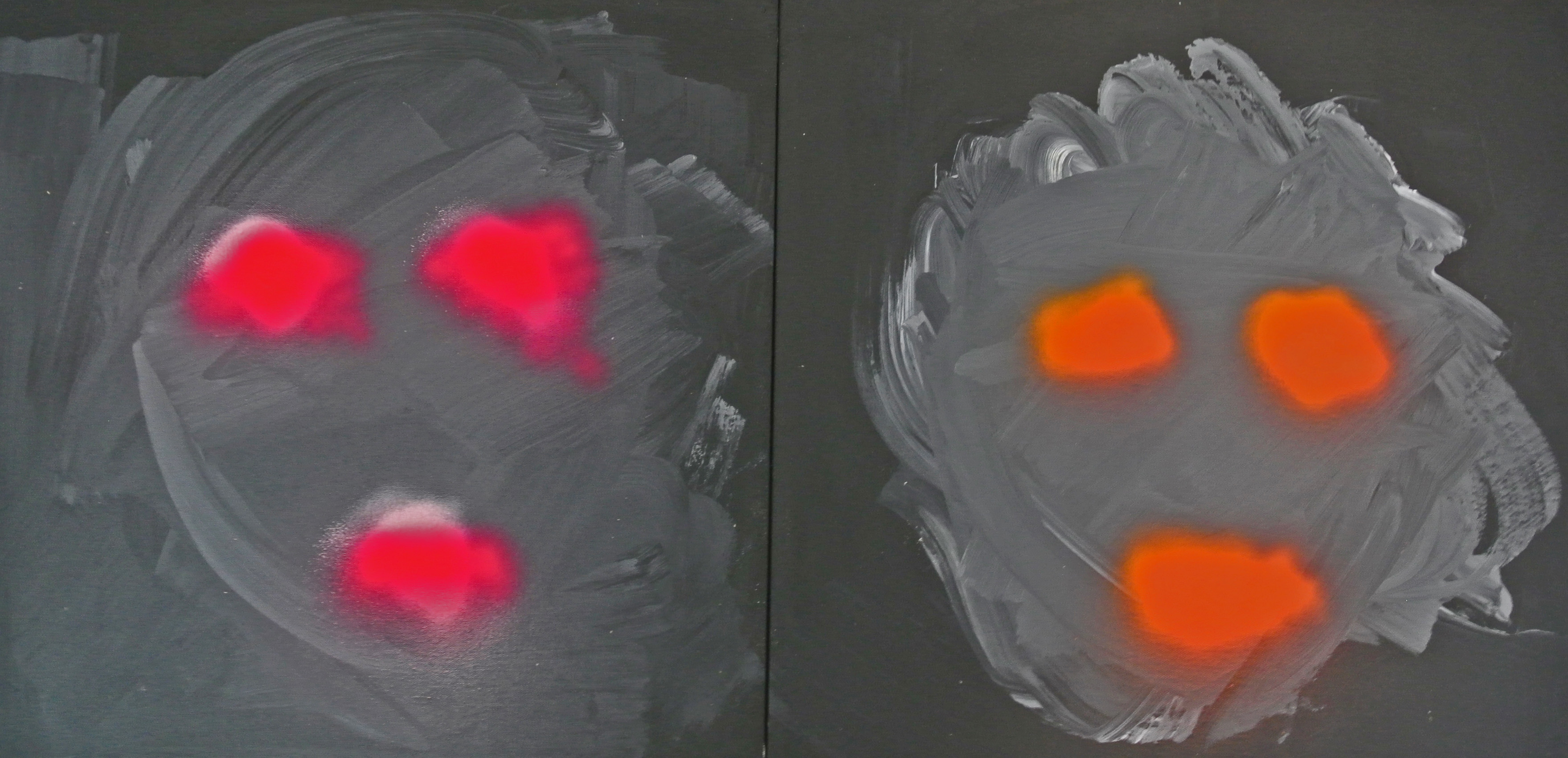
‘Faces, Faces Everywhere’ is a naive comment on a process developed from Sam Glankoff (1894-1982), who was a New York based, American artist. Glankoff developed an original technique that combined aspects of print-making and painting in an all-new, modernist genre titled “ print-paintings”.
In, ‘Faces, Faces Everywhere’ the outcome is a series of layered paints that are a clear reflection of this process undertaken. There is not enough diagnostic information in the individual features to clearly determine this work as portraiture, yet something about the overall organization of the image, the gestalt, is still allowing us to recognize a face.
Because of the nature of this particular approach, it is difficult to place this artwork within the traditional categories of painting or printmaking. It is not difficult however, to contend that it is neither painting nor printing in the purest sense.
– Melody Smith Gallery, PERTH AUS
‘Summer Mixer’ at Melody Smith Gallery is a platform for showcasing artists exhibiting in the 2014 exhibition program.
– Paper Mountain, PERTH AUS
I MAY LIVE ON AS A GHOST is layered with disparate influences, materials, processes, and cultural references. Some of these are deliberately revealed, others intentionally obscured. There is a sense of delight in colour and form, an irrevant use of materials; this adds further complexity to the work while allowing both viewer and artist to revel in it.
In Maciver’s practice, collages become landscape paintings become sculptural installations. These forms can only be separated out to a certain point before they double back on themselves, or morph into an entirely new thing. However, collages are often a formal starting point for Maciver (as well as works in their own right). He has said that his collage work ‘re-examines the various relationships to the photographic image: as documentation of truth, purveyor of memory, and symbol of modern culture’. Comprised of images torn from books, magazines, postcards, and other cultural detritus, these collages seem to float, defying the picture plane and refusing to settle into a comfortable arrangement. Their subject matter, too – like all of Maciver’s work – resists being pinned down. Signifiers jostle one another. A torn edge, a white cap; a landscape, an interior. A spray of paint, edges undefined.
This recontextualisation of images and meanings into a place of uncertainty for the viewer is a touchstone of Maciver’s process. The sculptural work ‘What It’s Like’, for example: once familiar objects with their own history and set of cultural signifiers, these have been reconstructed and tipped over, directly interacting with the shelf that is an idiosyncratic feature of the gallery (and which is itself a remnant of previous half-known histories). Seeing this striking object upturned in the space, it is as if something has just happened, a significant event the viewer has just missed. This feeling pervades the exhibition. ‘Goodbye Old Paint’: is it a mistake, a raw crumpled canvas discarded and left by accident on this pristine black-and-white plinth?
Maciver has produced several of these exhibited works in the gallery itself, in the weeks preceding the show. The works therefore interrogate the artist’s ongoing interaction with the space and its relationship to the artistic process.
The large-scale painting ‘NOW, That’s What I Call Music’ references the UK’s first commercially successful compilation album, released in 1983. This idea of a collection of popular tracks, drawn from many sources and curated into a new order, is directly aligned with Maciver’s artistic process. The painting itself is based on the album’s cover, but blurred and reworked beyond immediate recognition. One of the final works completed, this painting pulls all the works together into a dialogue about influences of popular culture, art history and materiality.
In this densely-layered exhibition, one strand of reference floats to the surface, then another. Maciver creates a space at once familiar, joyful and uneasy; a space where some things do become clear, but not until you’re right up against them.
Anna Dunnill
February 2013